

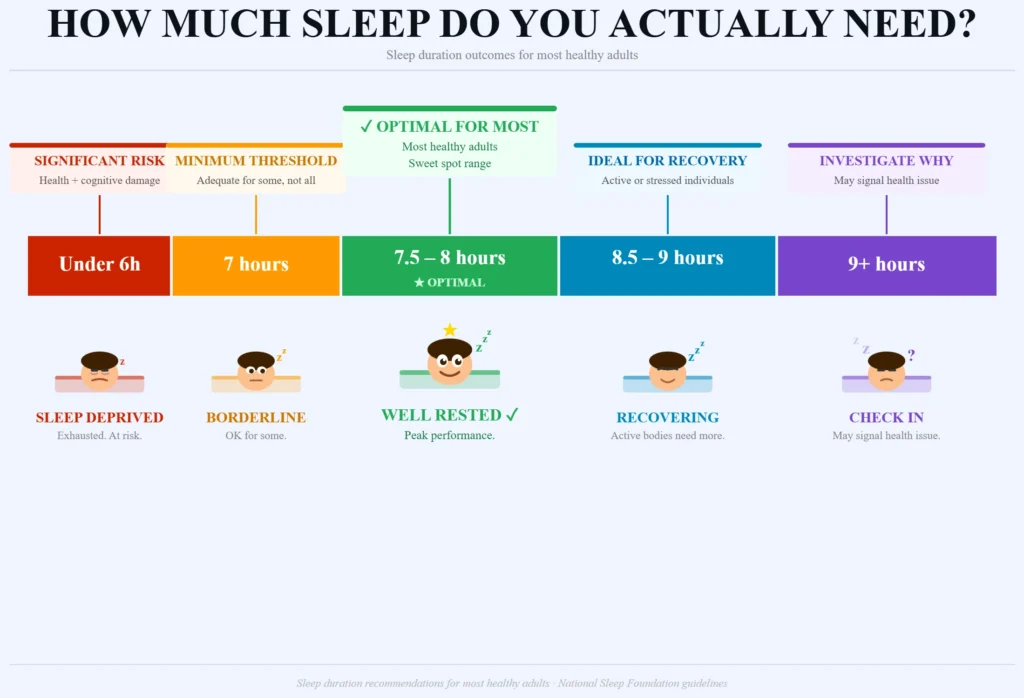
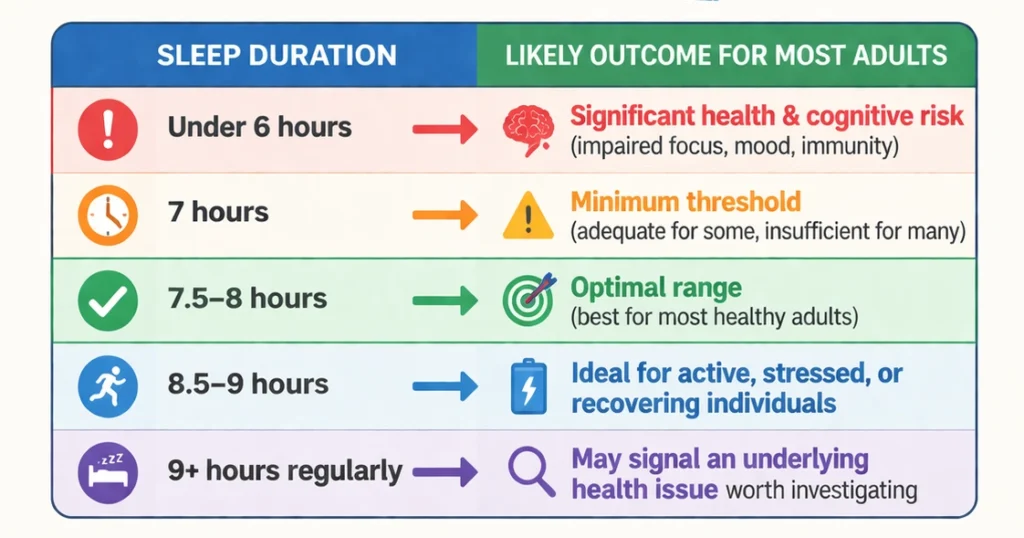
| Sleep Duration | Likely Outcome for Most Adults |
|---|---|
| Under 6 hours | Significant health and cognitive risk |
| 7 hours | Minimum threshold adequate for some, insufficient for many |
| 7.5–8 hours | Optimal range for most healthy adults |
| 8.5–9 hours | Ideal for active, stressed, or recovering individuals |
| 9+ hours regularly | May signal an underlying health issue worth investigating |
Adults need to sleep at least 7 hours every night to ensure good physical and mental health, or risk health complications down the track. People are rarely aware of, or appreciate, the extent to which their sleep is fragmented. Good sleeping habits and a regular sleep routine may help achieve this.

Signs 7 Hours Is NOT Enough for You

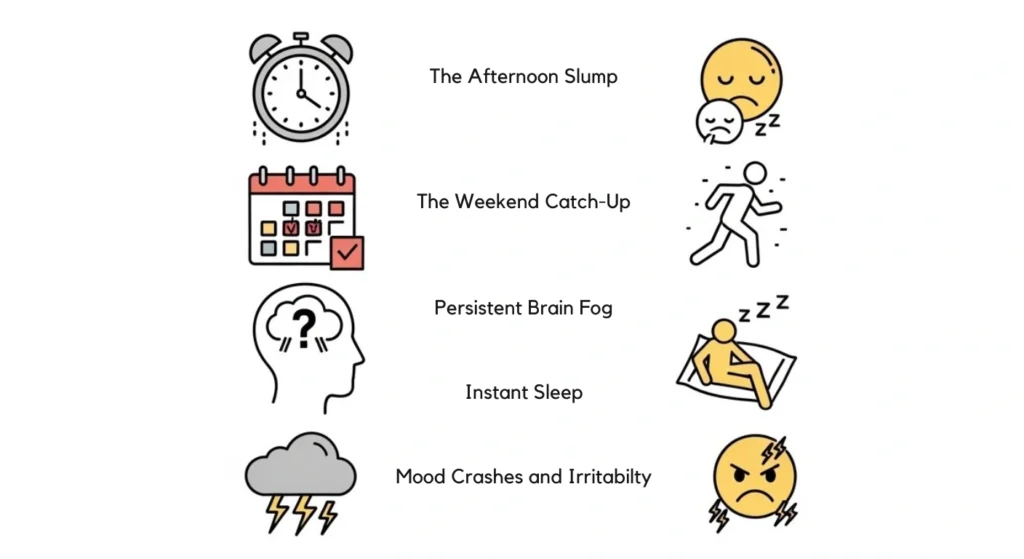
If you are hitting seven hours but still feel exhausted, your body is sending a clear signal. Watch for these red flags:
- The Afternoon Slump You crash hard at 2:00–3:00 PM and reach for sugar or caffeine just to stay functional.
- The Weekend Catch-Up You sleep 10+ hours on Saturday. This is your body repaying a sleep debt built up all week not a sign you are lazy.
- Persistent Brain Fog You struggle with word recall, memory, and simple decisions even after your morning coffee.
- Instant Sleep Falling asleep within five minutes of lying down sounds like a gift, but it is actually a clinical sign of severe sleep deprivation.
- Mood Crashes and Irritability Sleep loss directly impairs the brain’s emotional regulation centers. Small frustrations feel disproportionately overwhelming.
The National Institutes of Health (NIH) confirms that chronic sleep deprivation is linked to long-term mental health decline, not just daily fatigue.
The “7-Hour” Rule: Where Does It Come From?
The Centers for Disease Control and Prevention (CDC) and the National Sleep Foundation recommend that adults aged 18–60 get seven or more hours of sleep per night.
Seven hours is the statistical floor for health not the ceiling. Research consistently links sleeping below this threshold to:
- Higher risk of obesity and type 2 diabetes.
- Increased cardiovascular disease.
- Weakened immune function.
- Elevated cortisol and stress hormone levels.
Key point: “Seven or more” is a wide bracket. For many adults, seven is the minimum to function not the amount needed to truly thrive.
Quality vs. Quantity: The Hidden Factor
Total time in bed does not equal total time asleep.
If you spend seven hours in bed but lose time to phone scrolling, tossing, or mid-night waking, your actual sleep may be closer to six hours or less.
Sleep efficiency is the percentage of bed time spent genuinely asleep. Experts at the American Academy of Sleep Medicine (AASM) recommend at least 85% efficiency for restorative rest.
That means cycling fully through all four sleep stages:
| Stage | Type | Primary Role |
|---|---|---|
| Stage 1 | Light Sleep | Transition, body slows down |
| Stage 2 | Light Sleep | Heart rate drops, body temperature falls |
| Stage 3 | Deep Sleep | Physical repair, immune strengthening |
| Stage 4 | REM Sleep | Memory consolidation, emotional reset |
Missing deep sleep or REM sleep means your seven hours on the clock could feel like five in terms of recovery.
How to Find Your Personal Sleep
Genetics, age, stress levels, and physical activity all shape your ideal sleep window. Here is how to discover yours without guesswork.
Step 1 – The No-Alarm Test
Best done during a vacation or long weekend:
- Go to bed at your usual time.
- Do not set an alarm.
- Note when you wake naturally feeling rested.
- Repeat for 3–5 nights to identify your average.
Most adults naturally settle between 7.5 and 9 hours when freed from external pressure.
Step 2 – The 15-Minute Step-Up
If you feel sluggish on seven hours:
- Add 15 extra minutes of sleep each night.
- Assess your morning energy honestly.
- Keep adding 15-minute increments each week.
- Stop when you wake up feeling refreshed without an alarm.
Who Needs MORE Than 7 Hours?
Seven hours may fall genuinely short if you belong to any of these groups:
- Athletes and highly active people – physical health muscle repair demands longer deep sleep cycles.
- Chronically stressed individuals – high cortisol reduces sleep efficiency, requiring more hours to compensate.
- Anyone under age 25 – the developing brain requires 8–10 hours.
- People recovering from illness or surgery – cellular healing is almost entirely completed during sleep.
- Shift workers and frequent travelers – circadian disruption increases total sleep requirement significantly.
How to Maximize the 7 Hours You Have
If your schedule limits you to seven hours, protecting their quality becomes non-negotiable.
Eliminate Blue Light Before Bed Put your phone away 60 minutes before sleep. Blue light suppresses melatonin the hormone that signals your brain to initiate sleep.
Keep Your Room Cool A bedroom temperature of around 65°F (18°C) helps your body drop its core temperature a necessary biological trigger for entering deep, restorative sleep.
Maintain a Consistent Schedule Your circadian rhythm runs on pattern. Going to bed at the same time every night including weekends is one of the single most effective sleep interventions available, according to Harvard Medical School’s sleep research division.
Cut Caffeine After 2:00 PM Caffeine has a half-life of five to six hours. A 3:00 PM coffee still carries half its stimulant effect at 8:00–9:00 PM, directly delaying sleep onset and reducing deep sleep.
Do Not Use Alcohol as a Sleep Aid Alcohol may speed up sleep onset, but it fragments REM sleep in the second half of the night leaving you groggy even after a full seven hours in bed.
Get Enough Sleep 7 Hours?

Sleep is not a luxury you earn after being productive. It is the biological foundation that makes all productivity, performance, and health possible. Whether your number is seven, eight, or nine, consistency and quality are what unlock your best self.