


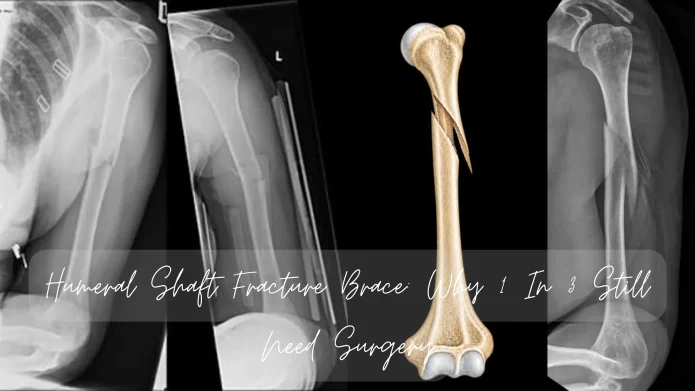
The brace is two plastic shells and some Velcro. It goes on about a week after you break the bone in your upper arm, once the swelling has come down, and you wear it day and night for two to three months while gravity and the muscles around the break line the ends up and let them knit. No operation, no metal, no scar. When it works, it works beautifully, and the surgeon who designed it, Augusto Sarmiento, published results in the 1970s and again in 2000 claiming that well over 9 in 10 fractures healed this way.
What the leaflet doesn’t say is that the picture has got less rosy since. When researchers in Finland ran a proper trial, giving one group surgery and the other the brace, about 1 in 3 of the brace group ended up on the operating table anyway, mostly because the bone never joined. If you’ve just been fitted with a brace, you deserve to know what it’s good at, what it isn’t, and how to tell early which group you’re in.
What A Humeral Shaft Fracture Is And Who Gets One
The humerus is the long bone between shoulder and elbow. A shaft fracture is a break in the middle section, away from either joint. It’s common in two groups that couldn’t be more different young adults after a fall onto the arm, a motorbike crash or, oddly, arm wrestling, and older adults, mostly women, after a simple fall from standing. The bone can snap straight across, break on a diagonal, spiral like a corkscrew, or shatter into several pieces, and the shape matters later on.
Around 1 in 10 people with this fracture arrive at hospital with a limp wrist and numb thumb, because the radial nerve wraps round the back of the humerus right where it breaks. That’s frightening and it usually recovers on its own over weeks to months. It’s also why the doctor will keep checking whether you can lift your wrist.
How A Functional Brace Is Supposed To Heal The Bone
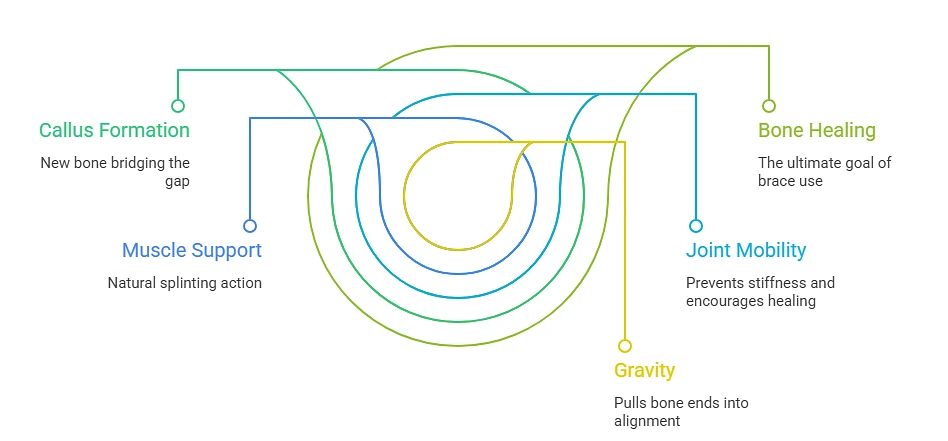
The idea is almost the opposite of a plaster cast. A cast holds the bone rigid. A functional brace holds the soft tissue snug, like a sleeve, and lets the elbow and shoulder move. The theory, and it’s borne out in practice, is that:
- The weight of the arm hanging down pulls the two ends of the bone into line.
- The muscles squeezing inside the brace act as a natural splint.
- Movement at the elbow and shoulder keeps those joints from stiffening and encourages the bone to lay down callus, the woolly new bone that bridges the gap.
So you’re told not to rest the elbow on anything, not to use a sling that lifts the arm, and to let it hang. It’s counterintuitive and it’s the whole point.
What The Weeks In A Brace Look Like
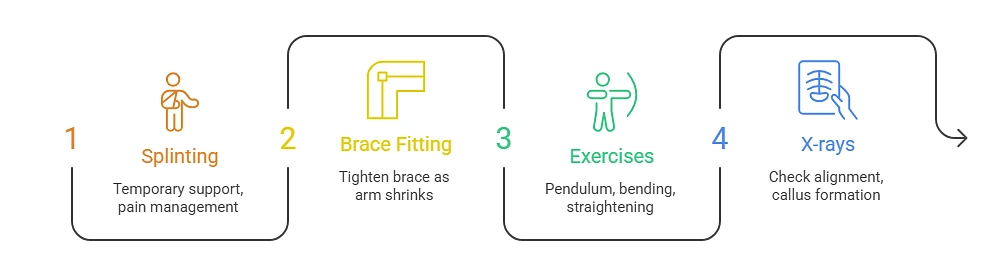
- Week 0 to 1: a temporary splint or plaster from shoulder to wrist while the swelling drops. This is the worst week for pain.
- Week 1 to 2: the brace is fitted. It should be tightened several times a day as the arm shrinks. A loose brace does nothing.
- From day one in the brace: pendulum exercises, leaning forward and letting the arm swing in small circles, and gentle elbow bending and straightening. Fingers and wrist moving constantly.
- Weeks 2, 6 and 10 to 12: X-rays to check the alignment and look for callus.
- Sleeping: propped up, half sitting, for the first few weeks. Lying flat lets the bone ends slide.
- Washing: the brace comes off briefly for a wash, with the arm held against the body, and goes straight back on. Take it off with a helper the first few times.
- Weeks 8 to 12: if the X-ray shows bridging callus and the fracture doesn’t move or hurt when the surgeon tests it, the brace comes off and physio starts properly.
A brace that isn’t tight is a brace that isn’t working, and most failures in the early weeks come down to that or to resting the elbow on the arm of a chair for hours.
How Many Braced Fractures Heal Without Surgery
This is where the honest answer got more complicated.
Sarmiento’s original series reported union in about 97 to 98% of patients. Those numbers were real, but the patients were carefully chosen, a lot were lost to follow-up, and the surgeon inventing the treatment was the one reporting the results.
Then came the trials that compared bracing to surgery head to head:
- The FISH trial (Finland, 2020, JAMA): randomised 82 adults. In the group given the brace, 30% crossed over to surgery, nearly all of them because the fracture hadn’t healed by the time the trial expected it to. In that trial the surgery patients had slightly better function at three months and no meaningful difference at a year, which is why bracing is still offered.
- The HUMMER trial (Netherlands, 2022): found that surgery got people back to function faster in the early months, with the gap closing later, and again a substantial share of braced patients ended up operated on for nonunion.
- Older reviews of everyday practice, outside trials, put the nonunion rate for bracing somewhere between 10 and 30%, depending on which fractures were included.
So the true picture is roughly this: most braced humeral shaft fractures do heal, but somewhere around a quarter to a third don’t heal cleanly on their own, and those people end up having the operation later, having spent three months in a brace first.
Which Fractures Are More Likely To Fail In A Brace
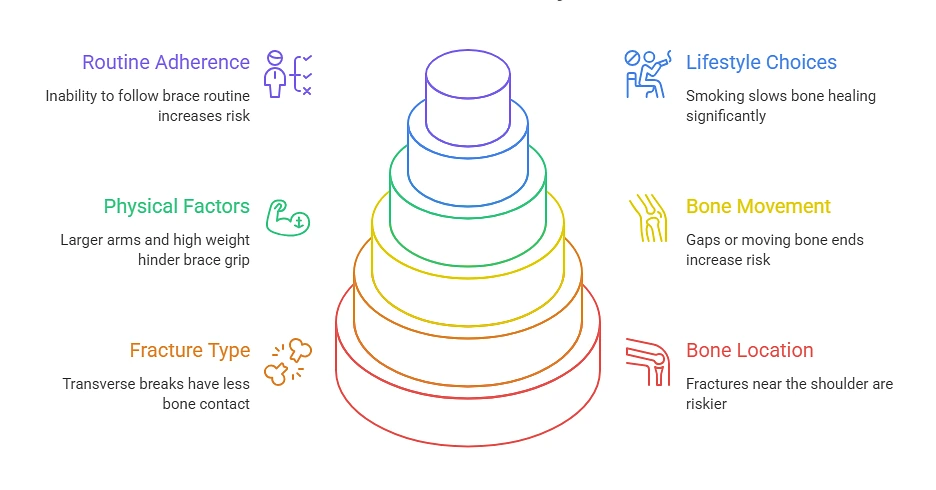
The 1 in 3 isn’t spread evenly. Some breaks are far more likely to join than others. The surgeons’ list, roughly:
- Fractures in the top third of the shaft, near the shoulder, where the brace can’t grip well and the pull of the muscles tends to angle the bone.
- Straight-across (transverse) breaks, which have far less bone surface touching than a spiral fracture and are harder to hold.
- A gap between the bone ends on the X-ray, or bone ends that keep moving apart.
- Larger arms and a high body weight, because the brace can’t compress the soft tissue enough to hold the bone.
- Smoking, which slows bone healing across every fracture there is.
- Being unable to follow the routine, whether because of dementia, a second injury, or a job that makes wearing a brace for three months impossible.
If you tick two or three of those, it’s fair to ask the surgeon at the first fracture clinic whether bracing is really the right starting point for you, or whether you’d rather operate now than probably operate later.
How To Tell Early If The Brace Isn’t Working
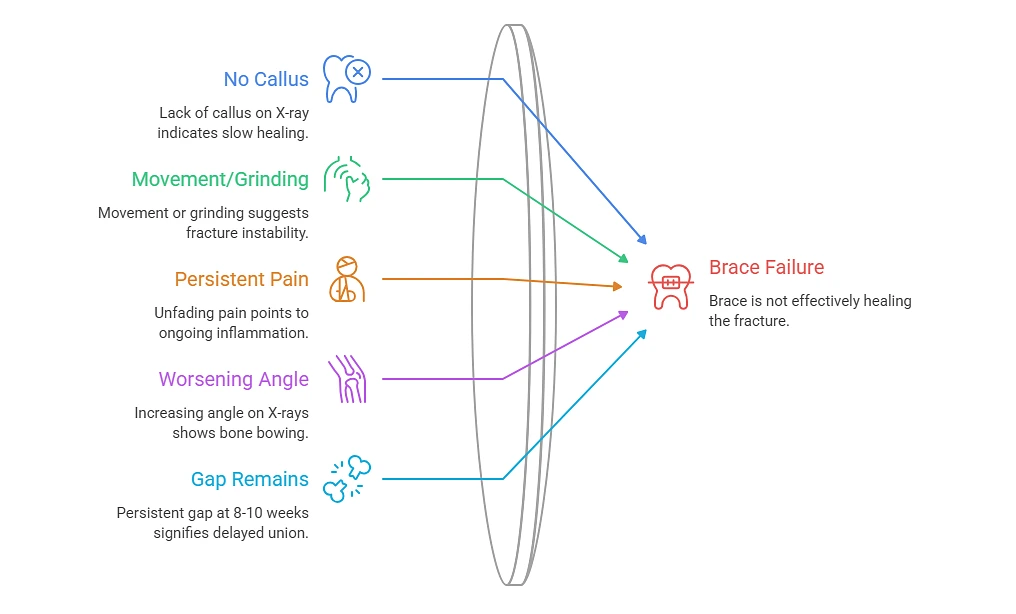
You don’t have to wait twelve weeks to find out. There are signs along the way.
- No callus on the six-week X-ray. Some cloudiness across the fracture line should be showing by then.
- Movement or a grinding feeling at the fracture when the surgeon presses, past about eight weeks.
- Pain at the break that isn’t fading week on week, especially pain with the small movements of everyday life.
- The angle getting worse on successive X-rays, with the arm visibly bowing.
- A gap that’s still there at eight to ten weeks.
Bone that hasn’t started to bridge by three months is unlikely to get there on its own, and by six months a fracture that hasn’t joined is called a nonunion and needs fixing. Most surgeons don’t wait that long once the pattern is clear.
What Happens If You Do Need Surgery After Bracing
Usually a plate and screws through a cut on the front or back of the arm, occasionally a rod down the inside of the bone. If the bone ends have gone hard and lifeless, a small bone graft from the hip is packed into the gap. The radial nerve gets found and protected during the operation.
Recovery after fixation is quicker than bracing in one way, because you can move the arm almost straight away, and slower in another, because you’ve had an operation and a wound to heal. People who go through both, brace then surgery, tend to say the hardest part was the months lost, not the operation itself.
References
- Rämö L, Sumrein BO, Lepola V, et al. Effect of Surgery vs Functional Bracing on Functional Outcome Among Patients With Closed Displaced Humeral Shaft Fractures: The FISH Randomized Clinical Trial. JAMA. 2020;323(18):1792-1801. https://jamanetwork.com/journals/jama/fullarticle/2765841
- Sarmiento A, Zagorski JB, Zych GA, Latta LL, Capps CA. Functional bracing for the treatment of fractures of the humeral diaphysis. J Bone Joint Surg Am. 2000;82(4):478-486.
- NHS. Broken arm or wrist. https://www.nhs.uk/conditions/broken-arm-or-wrist/