


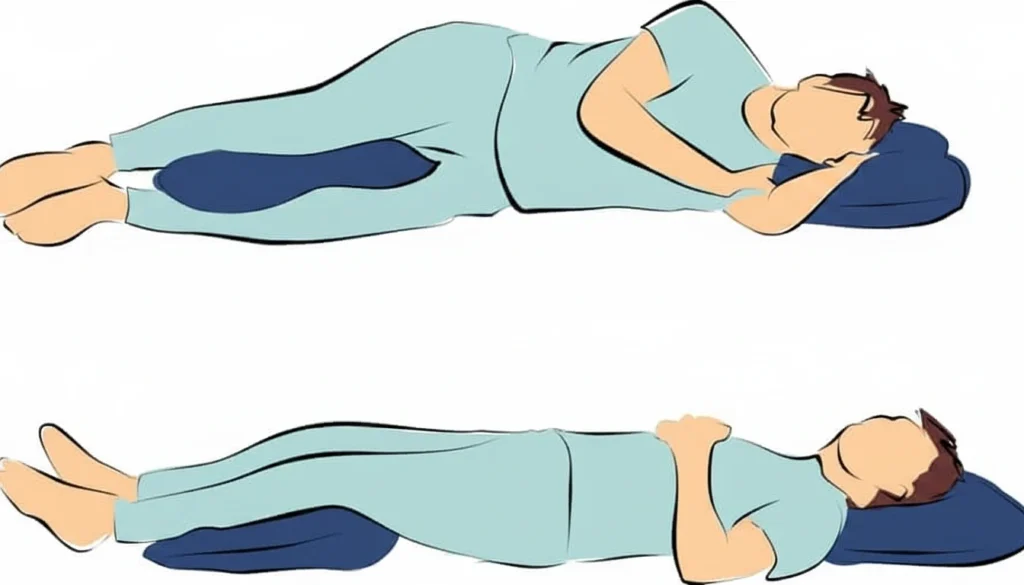
You spend about a third of your life sleeping. How you arrange your limbs during those hours has an impact on your back pain in the morning, your reflux at night or even how well your brain cleans itself out. Get it wrong and you can wake up with a crick in your neck. Get it right and sleep begins to do some work for your body.
Key Takeaways
The best sleeping positions prioritize spinal alignment and reduced pressure on joints, airways, and the digestive system. Side sleeping comes out on top for most people because it keeps the airway open, supports brain waste clearance, and reduces acid reflux when done on the left side. Back sleeping is a strong runner-up for spinal alignment when supported properly, and stomach sleeping is generally the position to avoid.

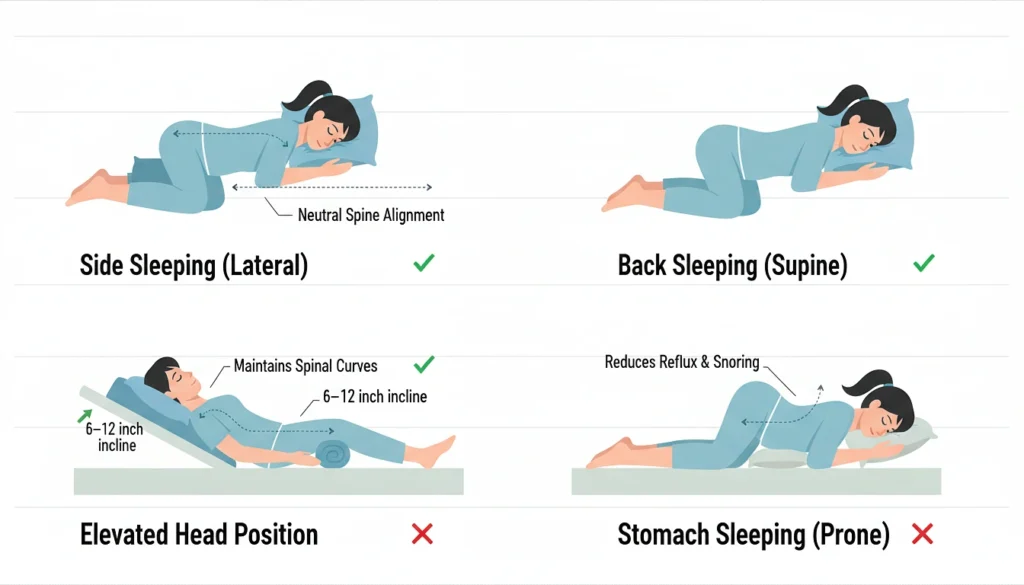
1. Side Sleeping (Lateral)
Lateral sleeping is the most prevalent sleeping position in humans and the best for most of us. This position maintains alignment of the spine, stops your tongue from falling back into the throat, and helps the brain clean house while you sleep.
Why it works:
- Reduces snoring and sleep apnea. Mayo Clinic experts note that sleeping on the back is the worst position for sleep apnea because the tongue and jaw fall back and crowd the airway, while side sleeping prevents airway collapse and reduces snoring (Mayo Clinic).
- Helps your brain detox. A 2015 Stony Brook University study published in the Journal of Neuroscience found that the brain’s glymphatic system the pathway that clears waste proteins like beta-amyloid linked to Alzheimer’s disease works most efficiently when you sleep on your side compared to back or stomach (Lee et al., Journal of Neuroscience, 2015).
- Eases acid reflux but only on the left side. A 2022 systematic review and meta-analysis published in the American Journal of Gastroenterology concluded that left-side sleeping reduces nocturnal reflux and improves GERD-related quality of life. Right-side sleeping does the opposite (Schuitenmaker et al., 2022).
How to do it right: Place a pillow between your knees to keep the hips, pelvis, and spine aligned. Your head pillow should fill the gap between your shoulder and ear so your neck stays level not tilted up or dropping toward the mattress.
2. Back Sleeping (Supine)
Sleeping on your back is great for your back, especially if you don’t snore or have sleep apnea. It keeps your weight spread out and your head, neck and back in a straight line.
Why it works:
- Back sleeping is widely considered the best position for spinal health because it evenly distributes weight and helps maintain the natural curves of the spine (Johns Hopkins Medicine).
- A small pillow tucked under the knees supports the natural lumbar curve and reduces lower back strain.
The catch: If you snore, have sleep apnea, or struggle with reflux, back sleeping can make all three worse. Lying flat lets the tongue and soft tissues block the airway. Avoid stacking multiple pillows under your head every inch your head pushes forward adds significant load to the cervical spine and can create a “text neck” posture overnight.
3. Elevated Head Position
A simple trick to improve sleep for certain health conditions is to sleep with the top half of your body elevated at a slight angle (about 6-12 inches, or a 12-degree incline).
The evidence:
- A clinical trial published in the Journal of Gastroenterology and Hepatology found that elevating the head of the bed by 20 cm reduced esophageal acid exposure, improved acid clearance time, and relieved heartburn and sleep disturbance in patients with nocturnal reflux (Khan et al., 2012).
- A separate in-home study published in JMIR Formative Research found that sleeping at a 12-degree incline produced a 7% relative reduction in snoring duration, 4% fewer awakenings, and 5% more deep sleep compared to sleeping flat (SleepScore Labs / JMIR, 2022).
A wedge pillow or an adjustable bed base achieves this more comfortably than stacking pillows, which tends to bend the neck rather than the whole upper body.
4. Stomach Sleeping (Prone)
One of the most common sleeping positions that is urged not to adopt is stomach sleeping. The National Spine Health Foundation reports this sleeping position is the worst for your spine because it distorts the natural shape of the spine, keeping the neck twisted.
If you can’t give up: Pillow under your head should be very thin or none and a pillow under the hips and lower abdomen. This flattens the curve in your lower back, relieving the pressure on your lower-back discs.
Special Cases: Position by Health Condition
Different conditions favor different positions. Here’s the quick decoder:
| Condition | Best Position |
|---|---|
| Lower back / neck pain | Back with pillow under knees, or side with pillow between knees |
| Snoring or sleep apnea | Side (either side) |
| Acid reflux / GERD | Left side, ideally with head elevated |
| Heart failure | Right side (with doctor’s guidance) left-side sleeping can worsen breathing for some heart failure patients (Healthline / Journal of the American College of Cardiology) |
| Pregnancy (later trimesters) | Left side, to improve blood flow to the placenta |
| Sinus congestion | Head elevated |
Universal Rules for Better Sleep, Whatever Your Position
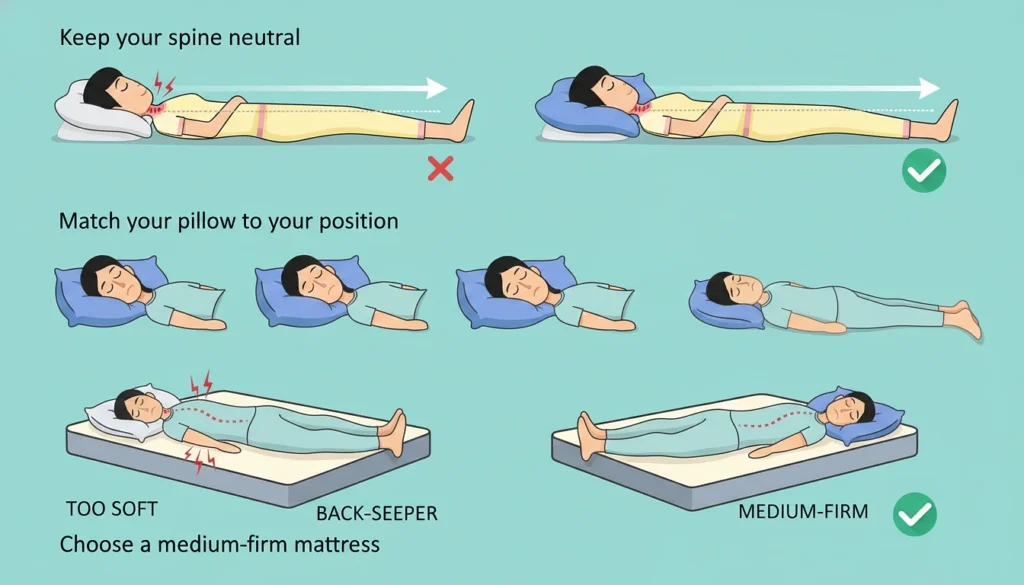
A few principles apply no matter how you sleep:
- Keep your spine neutral: Picture a line from the top of your head to the base of your spine. Your pillow shouldn’t alter that line, neither by angrily slamming your chin onto your chest, nor by cutting your chin off just below the ears.
- Specify what your sleep position: Side sleepers need a high pillows with firm support to fill the space under the head and shoulder. Back sleepers need a medium-loft pillow to keep the neck’s curve. Stomach sleepers need nothing at all.
- Pick a medium firm mattress: The mattress firmness studies agree that it is generally best for most adults to have a medium-firm mattress soft enough to support your body’s pressure points, firm enough to keep the spine upright.
- Comfort still matters: “Best” is the one you’ll most likely stick with. If you try to adapt to an uncomfortable position, you will just spend more time turning, which itself can disrupt sleep and reduce the deep sleep (or slow-wave sleep) phases when the body’s muscles and bones go into recovery.
The Bottom Line
For most adults, side sleeping particularly on the left side is the healthiest default position. It supports your spine, keeps your airway open, helps your brain clear waste overnight, and reduces acid reflux. Back sleeping is a solid alternative if snoring isn’t an issue. Stomach sleeping is the one habit worth retraining if you can.
It seems illogical to think a pillow between the knees, a wedge cushion under the body, sleeping with the knees bent instead of the back, make much of a difference, but when you consider some of the way we sleep many years of thousands of hours, the effects add up.